
Social Deception
Train teams on attacks indistinguishable from the real thing — from a console that runs campaigns, scores risk, and shows who still clicks.
One board for every campaign.
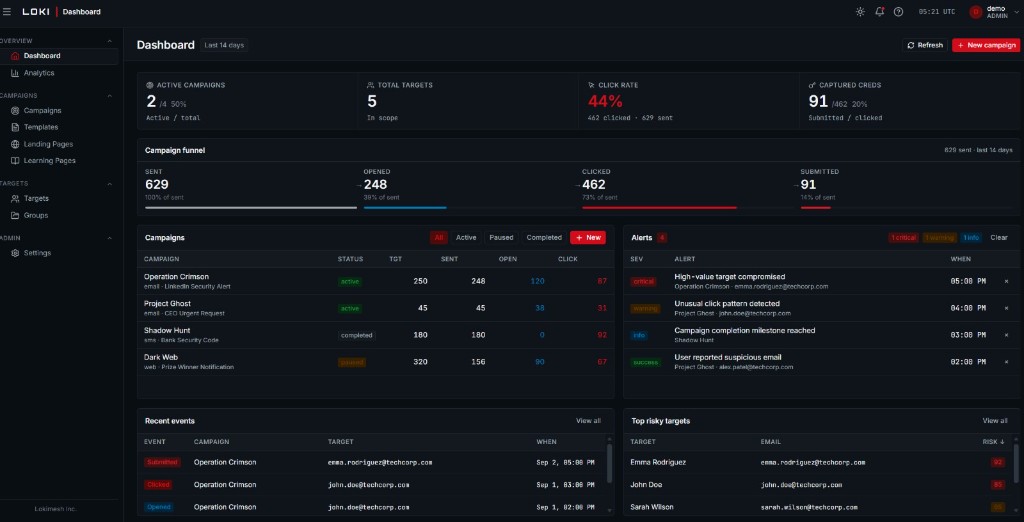
The dashboard is built for awareness operators. Campaigns, the funnel, alerts, and the people who need a closer look sit on one pane — so you run simulations without babysitting a spreadsheet.
- 01Posture in one strip
Active campaigns, targets in scope, click rate, and submissions land in the same row. If nobody is clicking, the board stays quiet.
- 02Campaign funnel
Sent, opened, clicked, submitted — the last 14 days as a single path, so you see where the lure held and where people fell through.
- 03Campaigns as they run
Active, paused, and completed sit in one list with sent, open, and click counts. Launch the next one from the same screen.
- 04Alerts and risky people
Critical hits, unusual click patterns, and users who reported the mail land next to a risk ranking — so follow-up is a person, not a log line.
Risk by person — not just by campaign.
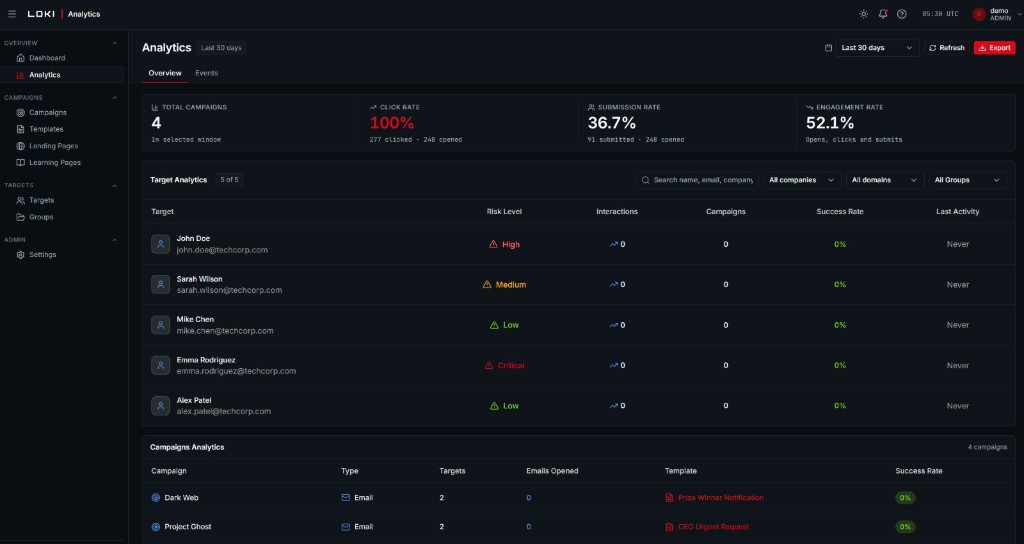
Analytics is how you prove the program is working. Click, submission, and engagement rates sit above a roster scored by risk, so training follows the people who still fail — not a generic annual course.
- 01Rates that mean something
Click rate, submission rate, and engagement over the selected window. Export when audit or the board asks for the same numbers.
- 02Filter the roster
Search by name, email, or company. Slice by domain and group so you are not reading the whole directory to find one team.
- 03Risk on every row
Critical, high, medium, and low travel with interactions, campaigns, and last activity — the same signal the dashboard already flagged.
- 04Campaigns underneath
Each lure — prize winner, CEO request, and the rest — shows type, opens, and success rate so you retire the ones that stopped teaching.
Know who is in scope — and who is exposed.
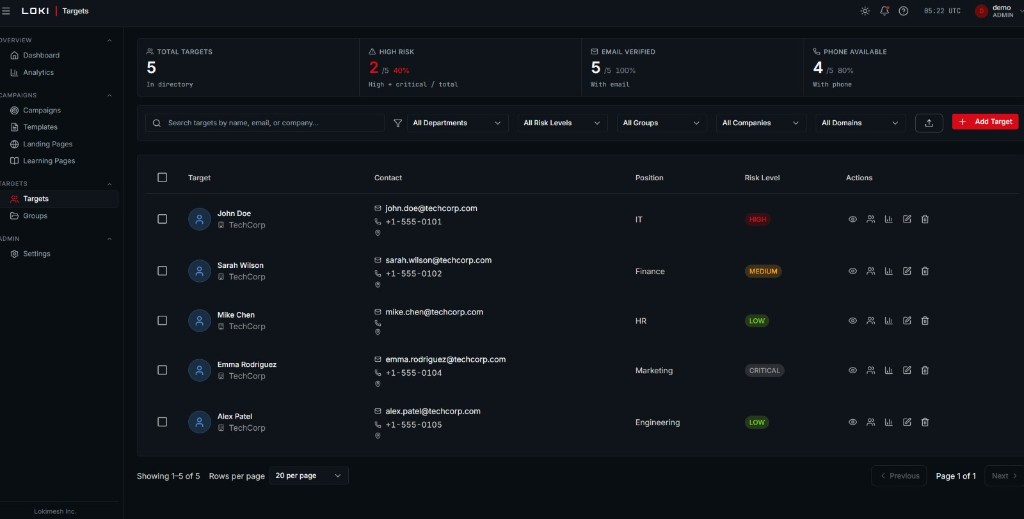
Targets is the roster campaigns are built on. Contact, department, and risk sit on every row, so you add people, group them, and send the next simulation without leaving the directory.
- 01Coverage, not a headcount
Total in directory, high-risk share, email verified, and phone available — so you know the campaign can actually reach the people you named.
- 02Find, then act
Search by name, email, or company. Filter by department, risk, group, company, and domain before you add or upload the next batch.
- 03Risk on the badge
Critical, high, medium, and low are on the row next to IT, Finance, HR — the same scores analytics uses to rank who still needs training.
- 04Person, not a list item
Open a profile, jump to analytics, edit, or remove without a second tool. Groups sit one click away when the campaign is ready.
Deception as protection.
Proactive protection
Train employees to recognize and resist social engineering before they become victims. Prevention through education beats reactive incident response.
Measurable results
Track effectiveness with detailed analytics on vulnerability rates, click-through metrics, and behavioral change over time.
Continuous improvement
Adapt to evolving threats with AI-powered simulations that stay current with attack trends — security culture as a living program.
Three engines that make phishing real.
AI-powered email templates
Generate highly convincing phishing emails with AI that analyzes attack trends, industry-specific threats, and your communication style. Sender spoofing, urgency manipulation, multi-language support — sub-2-second detection from user interaction.
Intelligent landing pages
100+ service templates (Office 365, G Suite, banking portals, social platforms) with AI-generated branding. SSL simulation, form-field tracking, behavioral analytics, automatic training-page redirects.
Campaign management & analytics
Launch at scale with automated scheduling, user targeting, and real-time tracking. A/B testing, segmentation, dashboards, training-platform integrations, and comprehensive compliance reporting.
What changes for your security org.
AI-powered phishing templates
Realistic phishing emails and landing pages that adapt to current attack trends and your organization context.
Realistic training scenarios
Highly convincing simulations mirror real-world attacks — employees learn against actual threats.
Instant remediation training
Targeted security training delivered automatically to users who fall for simulations — reinforces awareness in real time.
Automated campaign management
Launch and manage phishing campaigns at scale with automated scheduling, targeting, and follow-up training.
Where Social Deception ships first.
Compliance requirements
Meet regulatory training requirements with documented simulation campaigns and completion records.
Vulnerability assessment
Identify employees most susceptible to phishing and prioritize additional training for high-risk individuals.
New employee onboarding
Integrate phishing-awareness training into onboarding so new hires understand security risks from day one.
Security awareness training
Regular phishing simulations train employees to recognize and report suspicious emails — reduce click-through rates over time.
Ready to build a solid awareness program?
Talk to our team about how Social Deception lands in your awareness program — dashboard, analytics, and the target directory included.